ArcGIS Experience Builder is a powerful platform for building modern GIS applications but extending it beyond standard configuration using custom widgets introduces new challenges.
For many organisations, what starts as simple application development quickly expands into managing infrastructure, deployment pipelines, and ongoing operational overhead.
This article explores why this complexity occurs and how organisations are extending Experience Builder using custom widgets without taking on the burden of running the platform behind it.
For organisations operating in governed environments, this can be particularly relevant, as infrastructure, security, and lifecycle management introduce additional complexity.
The hidden complexity behind advanced Experience Builder use
As teams move from simple apps to more advanced use cases, several limitations emerge:
- Custom widgets are not supported directly in ArcGIS Online
- Hosting Experience Builder developer environments requires infrastructure and DevOps capability
- Deploying and operating applications introduces ongoing operational overhead
Individually, these challenges are manageable. Collectively, they create friction.
The result is slower delivery, increased reliance on IT teams, and a growing operational burden across the platform.
The trade-off organisations face
At this point, many organisations face a choice:
- Stay within standard Experience Builder capabilities and limit functionality
- Or move to developer workflows that introduce infrastructure, deployment pipelines, and operational complexity
Neither option is ideal.
What’s needed is a way to extend Experience Builder, without inheriting the overhead of running the platform itself.
Introducing Managed Experience Builder
Managed Experience Builder for ArcGIS was designed to remove this trade-off.
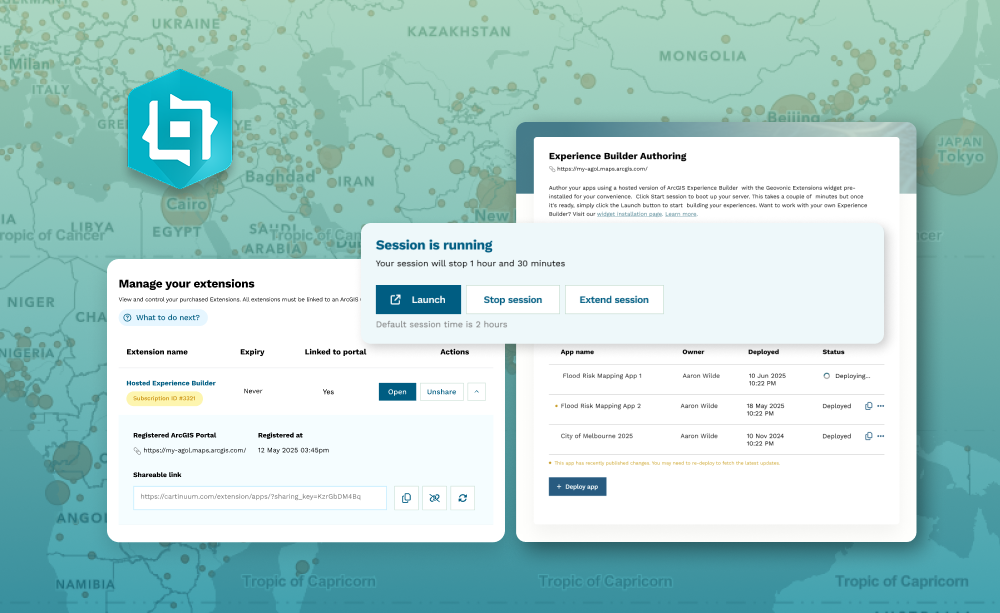
It is a fully managed platform that enables organisations to build and run advanced Experience Builder applications, without managing servers, environments, or deployment pipelines.
This allows teams to focus on building applications, not operating infrastructure.
What changes with a managed approach
With Managed Experience Builder, organisations can:
- Build applications using custom and third-party widgets
- Work with current Experience Builder versions independently of Enterprise upgrades
- Deploy applications instantly as globally available web experiences
- Enable collaboration across teams without managing shared infrastructure
In short, the platform removes the operational barriers that typically limit Experience Builder adoption.
How it works in practice
The platform delivers two key components:
- A secure, on-demand authoring environment for building applications
- A fully managed runtime environment for hosting and delivering them at scale
Importantly, all identity, access control, and data governance continue to be enforced by ArcGIS. There is no duplication of data and no alternative security model introduced.
More than hosting
A common misconception is to think of this model as “hosting Experience Builder”.
It’s not.
Managed Experience Builder is a complete application platform covering authoring, deployment, runtime, security, and operations, while Cartinuum manages availability, patching, and upgrades.
This distinction is critical for organisations operating in enterprise or regulated environments.
Who this is for
Managed Experience Builder is particularly suited to organisations that:
- Have mature ArcGIS Online adoption
- Require customisation beyond standard capabilities
- Operate in governed environments
- Need to deliver applications quickly without increasing operational overhead
This is why it resonates strongly across sectors such as government, utilities, and resources.
For ArcGIS Enterprise customers, Managed Experience Builder provides a practical way to extend Experience Builder with custom widgets while decoupling application delivery from ArcGIS Enterprise upgrade cycles. This enables teams to work with the latest ArcGIS Experience Builder capabilities when ArcGIS Enterprise environments may lag. This allows organisations to accelerate application delivery and avoid the complexity typically associated with maintaining separate environments alongside their core ArcGIS platform.
Unlocking the next stage of ArcGIS application delivery
Experience Builder has already changed how organisations deliver GIS applications.
The next step is removing the operational complexity that comes with scaling it.
Managed Experience Builder enables that shift, moving from configuration-led apps to fully extensible application environments, without adding infrastructure burden.
Ready to extend Experience Builder?
Extending ArcGIS Experience Builder doesn’t need to introduce infrastructure, complexity, or operational overhead.
With Managed Experience Builder, you can unlock advanced capabilities using custom widgets, while keeping your existing ArcGIS environment fully intact.
Get started today or explore pricing to see how it fits your organisation.


/Email%20Module%20Assets/linkedin.png)
/Email%20Module%20Assets/cartinuum_logo.png)
